State To State Medical Transport
We specialize in private, long-distance medical transportation across the lower 48 states, providing safe, comfortable, bed-to-bed transportation for patients traveling between hospitals, rehabilitation centers, nursing facilities, hospice providers, assisted living communities, and private residences. When it's time to choose the best medical transportation service, we stand apart with a custom-built medical transport vehicle, experienced medical support, premium onboard equipment, and personalized bed-to-bed care designed specifically for long-distance patient transportation.
Long Distance Stretcher Transportation
A hospital says your loved one is ready for discharge, but home is three states away. Or a rehab facility has accepted the patient, yet the trip is too long for a wheelchair van and too medically sensitive for a commercial flight. This is where long distance stretcher transportation becomes more than a ride. It becomes a carefully managed medical transfer built around safety, comfort, and peace of mind.
For many families, this kind of transportation is unfamiliar until they need it. The patient may not be in an emergency, but they still cannot sit upright for hours, manage airport lines, tolerate a standard car trip, or travel without support. In those moments, the right service needs to do two things well at the same time - protect the patient medically and reduce the stress on everyone involved.
What long distance stretcher transportation actually means
Long distance stretcher transportation is private, non-emergency medical travel for patients who must remain lying down during extended trips. It is commonly used for interstate moves, hospital discharges, rehab transfers, specialist appointments, return-home trips, and relocation closer to family.
Unlike emergency ambulance transport, the goal is not rapid response. The goal is stable, comfortable, medically supported travel over many hours or across multiple states. Unlike shared medical transportation, it is centered on one patient at a time, with a private environment and a plan tailored to that person's condition.
A patient recovering from surgery, living with advanced dementia, using oxygen, or dealing with limited mobility may be medically stable enough for non-emergency transport but still not safe in a standard vehicle. Long-distance travel creates its own strain. Positioning, pain control, bathroom planning, oxygen needs, fatigue, and confusion can all become more difficult as the miles add up.
Who typically needs long distance stretcher transportation
This service is often the right fit when a patient cannot tolerate seated travel for the full trip. That includes people leaving the hospital after a serious illness or procedure, patients transferring between care settings, and older adults relocating to live near family or enter a new facility.
It is also common for medically complex travelers who need continuous support on the road. Someone who depends on oxygen, needs vitals monitored, requires medication to stay refrigerated, or becomes disoriented in unfamiliar environments may need a controlled travel setting rather than a public or basic transport option.
What a premium trip should include
Not all stretcher transport is the same. While basic transportation may be enough for a short local transfer, interstate and cross-country trips require a much higher level of planning, comfort, and medical support.
A premium long-distance transport should provide bed-to-bed service, meaning the patient is assisted from the point of origin to the final destination rather than being left to manage difficult transitions alone. That includes coordination around pickup and arrival, which can make a major difference for families already handling discharge paperwork, facility communication, and personal logistics.
The onboard environment matters just as much. A specialized stretcher bed, climate-controlled cabin, oxygen availability, and vitals monitoring help keep the trip safe and tolerable over long stretches of time. For some patients, comfort is not a luxury. It is what prevents the journey from becoming physically overwhelming.
Medical support should also be matched to the patient's needs. Some travelers need only careful supervision and assistance with repositioning. Others need respiratory support, medication management, or closer monitoring due to their condition. The best providers explain clearly what is included so families understand the level of care during transit.
Privacy is another major benefit that families sometimes do not fully appreciate until they compare options. A private transport setting reduces confusion, noise, exposure to crowds, and unnecessary handling. For patients with dementia, post-surgical pain, respiratory conditions, or anxiety, that calmer environment can make the entire experience more manageable.
Long distance stretcher transportation vs other travel options
Families often compare stretcher transport with ambulances, wheelchair vans, flights, or a self-managed road trip. Each option has a place, but the right choice depends on the patient's condition, distance, and tolerance for travel.
Emergency ambulance services are designed for urgent medical situations. If the patient is unstable or needs emergency-level intervention, that is the correct resource. But for non-emergency transfers over long distances, an ambulance may not be the most practical or appropriate fit.
Wheelchair transportation works well for patients who can sit upright and transfer safely. Once a patient needs to remain lying down, has pressure concerns, severe weakness, or cannot tolerate seated travel for extended periods, a wheelchair vehicle is usually no longer enough.
Commercial air travel can seem faster on paper, but it often involves the very stressors fragile patients handle poorly - transfers, waiting times, security lines, airport noise, public exposure, and limited flexibility. Even when special accommodations are available, the total travel burden may be too high.
A family-driven road trip may also seem like a practical solution, but transporting a medically fragile patient over long distances involves far more than driving. Positioning, restroom needs, oxygen management, medication, fatigue, and continuous monitoring can quickly become overwhelming without the proper vehicle and support. Choosing specialized long-distance stretcher transportation allows families to focus on their loved one while experienced professionals manage the journey.
Vehicle Designed For NationWide Medical Transport
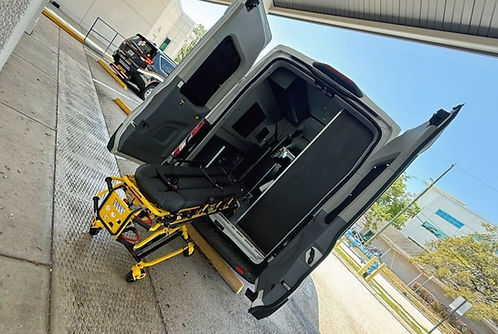
Our custom-built medical transport vehicle is designed specifically for safe, comfortable, and reliable long-distance patient transportation across the lower 48 states. Unlike a standard ambulance or wheelchair van, every detail has been carefully engineered to support extended interstate travel while providing a private, stress-free environment for patients and their families.
Inside, patients travel on a medical-grade specialized memory foam stretcher mattress designed to maximize comfort during long-distance trips. The vehicle also features a climate-controlled cabin, onboard power, oxygen capabilities, secure medical equipment storage, and space for continuous monitoring throughout the journey. Whether transporting a patient from a hospital, rehabilitation center, nursing facility, hospice, or private residence, our goal is to provide a smooth bed-to-bed experience with comfort, dignity, safety, and peace of mind from pickup to destination.

Stretcher + Captain Chair Transportation
Our custom-built medical transport vehicle is designed to safely accommodate both stretcher and ambulatory patients on the same trip. Whether one passenger requires a medical-grade stretcher while another travels in a premium captain's chair, everyone remains together in one private vehicle without sacrificing comfort or safety.
Unlike a standard ambulance or passenger van, our vehicle was purpose-built for long-distance medical transportation. It features a medical-grade specialized memory foam stretcher mattress, spacious interior, premium reclining captain's chair, privacy curtains, climate-controlled cabin, onboard power, refrigerated medication storage, oxygen support, and room for essential medical equipment.
This configuration is ideal for families traveling together, spouses accompanying one another, or patients who may begin or end their journey in a captain's chair while still having immediate access to a stretcher if needed. Every transport is private, bed-to-bed, and tailored to the patient's medical condition, providing a safe, comfortable, and dependable experience across the lower 48 states.

Why Long-Distance Stretcher Transportation?
When a patient is confined to a bed or cannot safely remain seated for extended periods, traveling in a standard passenger vehicle, wheelchair van, or other transportation not designed for their medical needs can quickly become uncomfortable and physically demanding. Hours in a seated position may increase fatigue, discomfort, pressure, and unnecessary strain, making an already difficult journey even harder.
That is why long-distance stretcher transportation is designed differently. Instead of asking the patient to adapt to the vehicle, the vehicle is built around the patient's condition. Patients remain comfortably positioned on a medical-grade specialized memory foam stretcher mattress throughout the journey, allowing them to rest naturally while reducing unnecessary movement during long-distance travel.
At NationWide NEMT, every transport is planned with the patient's comfort, safety, and dignity in mind. Our custom-built medical transport vehicle provides a spacious, private environment equipped for long-distance travel, including bed-to-bed transportation, oxygen capability, onboard power, refrigerated medication storage, climate control, privacy curtains, and room for essential medical equipment.
When choosing the best long-distance medical transportation service, experience and specialized equipment matter. Whether traveling from a hospital, rehabilitation center, skilled nursing facility, hospice, assisted living community, or private residence, our goal is to make every mile as safe, comfortable, and stress-free as possible for both the patient and their family.